Yazdi

54 posts

LIKE FATHER, LIKE SON | Review


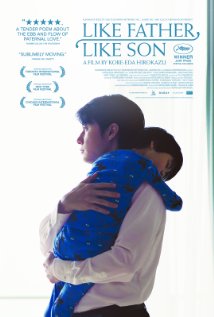
Two couples find out that their five-year old sons had been switched at birth.  Think about this premise, and then imagine what most filmmakers might have done with it. To see what Hirokazu Kore-Eda does with this story is to recognize why he is one of the master filmmakers. LIKE FATHER LIKE SON (SOSHITE CHICHI NI NARU) stands head and shoulders above any film I have seen so far this year.

MV5BMTU5MzgzODkwNV5BMl5BanBnXkFtZTgwNDUwNjg3MDE@._V1_SY317_CR0,0,214,317_
Hirokazu Kore-Eda’s latest film LIKE FATHER LIKE SON


The film presents a fascinating moral quandary. The discovery of a son you weren’t previously aware of is one thing. But that still cannot match the anxiety of knowing that the child you did rear as your own now legally belongs to other parents who could forcibly take him away. Does it matter that the children in this film are only five years old, in that formative phase when they are most impressionable? Would it have been easier if the children were younger?  Is it better to just quickly “exchange the kids” as suggested by the lawyers representing the hospital where the mix-up occurred at birth? What carries greater moral imperative: nurture or bloodline? Confronted with this premise, most of us might say that this would be an easy decision: your child is the one you have loved and cared for as your own, not the one connected by genetics; keep the child you have, and bloodline be damned. But the film argues that the situation might not be as simple.  How are you to observe a child grow up with other parents and see him start to physically look increasingly like yourself?


Consider the two couples. Ryoto Nonomiya is an aggressively competitive businessman on the fast track to corporate success. His stay-at-home wife, Midori has given up her career to care for their son Keita. Several characters in the film comment that the Nonomiya home in a gleaming high-rise reminds them of a hotel room. This is a family that is not lacking for much. Yudai Saiki works outside of the city in a somewhat run down appliance store and his wife Yukari is employed at a fast-food chain. They support their three kids including the mischievous Ryusei. The paths of the two disparate families intersect when genetic testing initiated by the hospital confirms that Keita and Ryusei were switched at birth.


This story could have lent itself to any manner of tonal or stylistic construct. This might have been a bitter, angry film. It might have been a legal procedural. It might have been a deep, soggy wallow of a movie. But LIKE FATHER LIKE SON is none of those things.  Instead the film is elevated because the treatment given to this material is one of quiet observation. Kore-eda has been called an heir to Ozu for reason, not least because of his ability to watch his characters from afar without judgment. And this movie is no exception. It has no interest in melodrama; you will not find a shrill note here. And then there is the one thing about Kore-Eda’s work that makes him one of my favorite filmmakers: he refuses to create villains. There isn’t a mean character in any of his films. Not the over-ambitious Ryoto in LIKE FATHER LIKE SON, not the strict patriarch in WALKING STILL, and not the absent mother in NOBODY KNOWS. Kore-Eda recognizes that people are seldom all-out malevolent, and to his great credit as a scriptwriter, he has never granted himself an easy out by generating conflict by way of an ill-intentioned character. No, the people who populate his stories all mean well; their actions are driven by who they are and their behavior is conditioned by their upbringing and values. But they are all, without exception, decent people. This is what makes Kore-eda the most humanist of all filmmakers working today.


Does it matter that this story plays out in Japan? Not one bit; this film could have been set anywhere in the world. The grandparents are recognizable in their yearning to see more of their children and grandkids, while walking a fine line with not overstepping. Observe the grace and  uncannily natural rhythms captured from the child actors here. And when you have as gentle, nonjudicative, and keenly observant a filmmaker as Kore-Eda, the experiences of a specific few slowly begin to reflect the universe. Notice how the specifics of the two families in LIKE FATHER LIKE SON are used to make deft observations about class differences. The Nonomiyas are the definition of cultured living: they eat healthy, have their son tutored for piano, and live in a catalog-ready home. The Saikis are struggling to make ends meet, live in a much smaller space, and are frequently late; but they are also quick to the laugh and agreeably content. When the Nonomiyas suggest that they are financially capable of taking care of both sons, the one they have reared as their own as well as their biological child, the Saikis bristle with honest indignation. See how easy it would be for this film to tip over, if even very subtly, with its sympathies toward one family. It would have been easy to call the rich couple out for their patronizing, intellectual detachment, or call the other couple out for being irresponsible and crude. But the film resolutely does not. It quietly makes it clear that each set of parents are well-meaning and generous in their love for their children.  They may be flawed, but both sides are inarguably decent.


It is in this recognition of the decency of those who love a child that the film ultimately provides an abiding definition for family; the only one that matters.  That it does so apolitically, unemotionally and with authenticity, is cause for gratitude.


LIKE FATHER LIKE SON is screening in San Diego at the Landmark Hillcrest cinemas February 14-20. http://www.landmarktheatres.com/Market/SanDiego/SanDiego_Frameset.htm

THURSDAY TILL SUNDAY (De Jueves A Domingo) | Review


THURSDAY TILL SUNDAY (DE JUEVES A DOMINGO), by first time director Domingo Sotomayor Castillo is a Chilean film that is constructed almost entirely from the unsaid, the perceived, the things lurking just outside the reach of what is literally seen. It is an immersive experience. Nominally, the film covers a road trip taken by a couple, their daughter, and young son over four days.

images-4-1The movie is seen for the most part through the eyes of the teenaged daughter. Approaching neorealism, this is a work of stark austerity which may tempt a viewer to assign it hastily to the ignoble genre of films where ‘nothing happens’.  The studiedly documentary feel, the naked abandon of traditional plotting, and the patient, unrushed lingering of the camera over these four characters, may unsettle at first. But stop trying to deduce the film on a minute by minute basis, settle into its rhythms, and see how it will breathe alongside you. This is a film that trusts the intelligence of the viewer enough to not provide easy, obvious answers. And demands that the viewer bring their own experiences to glean what they will from this story.

Slowly the cracks in the relationships come into focus, sometimes ever so briefly. And one begins to comprehend that the entire film might be a hazy recollection, an evocation of a child’s earliest memory of the first sign of the dissolution of their parents’ marriage. The movie deftly evokes a sense of nostalgia – for a time when being a child meant not having the tools to decipher what the behavior of adults signified.

The young daughter is never precocious, or all knowing, and the actor who plays her (Santi Ahumada) brings an effortless naturalism that belies any knowledge of a camera being around her, and captures all the complexities of being a teenager: distracted, self-involved, impatient – but, always well-meaning. In the Q and A after the film at the Los Angeles Film Festival where the film screened in 2012, the director revealed that the four-year old who played the younger brother was obviously not up to acting in the traditional sense, and the other actors learned to ad-lib and work around his natural behavior on camera. No wonder the film evokes a feeling of purity about it.

The wonderful, deeply meditative THURSDAY TILL SUNDAY is screening at the Digital Gym Cinema in San Diego. Any lover of cinema owes themselves a viewing of this film.  February 14-20. http://digitalgym.org/thursday-till-sunday/


OUT OF THE FURNACE | Review

OUT OF THE FURNACE is a well-made film. I respect its discipline and its hard-working craft. But I cannot abide by what it represents.

MV5BMTc2MTQ4MDU4NV5BMl5BanBnXkFtZTgwOTU1ODgzMDE@._V1_SX214_And what it represents is another one of those Americana tales that is going for the mythic by way of violence. It is achingly blue-collar – with the collar so scuffed with the dirt and grime of hard-working, economically hurting Americans that it might as well be brown-collar.

Christian Bale plays older brother Russell in the economically frayed industrial Northeast. He is trying to curtail Rodney his more impetuous sibling (played by Casey Affleck), who has just returned from a war deployment and is getting involved with backwoods criminals in an effort to earn some money. Soon upon return from jail after serving time for an accidental killing, Russell finds his brother missing. And has to deliberate on options for trying to find Rodney.

There is much to appreciate about the film’s commentary on many things. About how there is dignity in the lives of those working hard, to get by. By working in mills, by taking care of aging parents, by going off to fight the country’s wars, by taking ownership of honest but no less irreversibly harmful mistakes.  The movie does a fine job of conveying the nobility of its characters. It is hard to do this without patronizing, and the film and its amazing actors manage to reflect these lives with remarkable authenticity.

But then why soil this hard-won authenticity with savage violence. The film begins and ends with violence as horror. And then in the middle tries to find poetry in revenge. And it is this poetry in revenge that I couldn’t bring myself to buy. What is this film saying? That there are monstrous people in the world and the only way to deal with them is by retaliatory blood-letting?

I know the film is not trying to deliberately do so, but in this grim, acutely considered American tale about the degradation resulting from violence, the film instead reveals its own unhealthy fascination for violence. People are killed off ruthlessly – and quickly – leaving one wondering as to what this director was aiming for? To make the point that this happens in real life?  Maybe so, but why should this make for good cinema?

I have tremendous appreciation for Christian Bale who completely possesses this role.  Here again is reason, if you ever needed one, that Bale is best in class amongst his generation of actors. And for Casey Affleck, who is turning in consistently believable, complex turns in film after film these days. And Woody Harrelson who makes you look away in fear every time he is on screen, which is saying something considering his more recent filmography of scary bad men. There is a scene halfway through the film where Christian Bale reaches out to Zoe Saldana in a park, hoping to win back her love. It is spare, and beautifully written and sublimely acted, especially by Bale. He breaks your heart. I wish the film had towed more closely to these characters and their lives as its reason for being.

Rare is the film that touches upon so many contemporary American issues. Including how we do not seem to have a place of stability, or even dignity, for soldiers returning from war. The situation created with Bale’s character getting involved in a car accident that results in fatalities is handled with uncommon deft; how often have you see a film delve into the resultant hopeless and crippling guilt. There is so much to be said with these players in this setting. It is disappointing then that the film chooses instead in its final act to settle for being a grotesque revenge tale.

Scott Cooper, the director made his debut helming CRAZY HEART a few years ago, and that film too was about a weathered, beaten character who is trying to claw out of the hell of his addictions and failings. But that film was ultimately about redemption and so found grace in its final notes. There will be those who fill find grace in the final notes of OUT OF THE FURNACE too. I am just not one who can get behind a validation, no matter how genuine, no matter how to the bone and unadorned as it may be, but a validation no less for an-eye-for-an-eye.


2013 San Diego Film Critics Society winners announced

Members of the San Diego Film Critics Society gathered this morning to take the nominations from yesterday to the next step. Votes were cast in each of the categories below. And several categories needed subsequent run-off voting. And here are the winners!  The 553302_413308895351616_1785528151_awealth was spread wide. And I would say the group got it right for the most part.


Best Film: HER

Best Director: Alfonso Cuarón, GRAVITY

Best Actress: Cate Blanchett, BLUE JASMINE

Best Actor: Oscar Isaac, INSIDE LLEWYN DAVIS

Best Supporting Actress: Shailene Woodley, THE SPECTACULAR NOW

Best Supporting Actor: Jared Leto, DALLAS BUYERS CLUB

Best Original Screenplay: Spike Jonze, HER

Best Adapted Screenplay: Richard Linklater, Julie Delpy, Ethan Hawke, BEFORE MIDNIGHT

Best Foreign Language Film: DRUG WAR

Best Documentary: THE ACT OF KILLING

Best Cinematography: Emmanuel Lubezki, TO THE WONDER

Best Animated Film: THE WIND RISES

Best Editing: Christopher Rouse, CAPTAIN PHILLIPS

Best Production Design: Catherine Martin and Karen Murphy, THE GREAT GATSBY

Best Score: Arcade Fire, HER

Best Ensemble Performance: AMERICAN HUSTLE

Kyle Counts Award: Destin Daniel Cretton (Director, SHORT TERM 12)


San Diego Film Critics Society announces its 2013 nominations for best of the year

It is the time of the year when film review groups around the country start announcing their year-end picks in the major categories. The New York Film Critics Circle bestowed their best picture prize on AMERICAN HUSTLE, a soon-to-be-released Scorcese-esque caper film set in the 70’s, the latest from director David O. Russell (SILVER LININGS PLAYBOOK, THE FIGHTER). The National Board of Review picked HER, the wistful new Spike Jonze film set in a not so distant future, and about a man who falls in love with the his computer operating system. With those two groups out of the gate first, many other reviewer groups have followed in the past few days. And so far, the winners have been blissfully inconsistent, which promises to make for an exciting awards-season.

The San Diego Film Critics Society (of which Moviewallas is a member) announced this afternoon their nominations in all of the top categories. The voting occurs tomorrow morning and the winners in each category will be declared later in the day. We will be sure to post the final winners here, but below are the top five picks in each category (nominations), which may help guide your movie watching plans over the holiday break.

BEST FILM
12 YEARS A SLAVE
GRAVITY
HER
INSIDE LLEWYN DAVIS
SHORT TERM 12

BEST DIRECTOR 
Alfonso Cuarón, GRAVITY
Destin Cretton, SHORT TERM 12
Joel and Ethan Coen, INSIDE LLEWYN DAVIS
Spike Jonze, HER
Steve McQueen, 12 YEARS A SLAVE

BEST ACTRESS 
Adèle Exarchopoulos, BLUE IS THE WARMEST COLOR
Brie Larson, SHORT TERM 12
Cate Blanchett, BLUE JASMINE
Emma Thompson, SAVING MR. BANKS
Sandra Bullock, GRAVITY

BEST ACTOR 
Chiwetel Ejiofor, 12 YEARS A SLAVE
Joaquin Phoenix, HER
Matthew McConaughey, DALLAS BUYERS CLUB
Oscar Isaac, INSIDE LLEWYN DAVIS
Tom Hanks, CAPTAIN PHILLIPS

BEST SUPPORTING ACTRESS 
Elizabeth Banks, THE HUNGER GAMES: CATCHING FIRE
Jennifer Lawrence, AMERICAN HUSTLE
Lupita Nyong’o, 12 YEARS A SLAVE
Sally Hawkins, BLUE JASMINE
Shailene Woodley, THE SPECTACULAR NOW

BEST SUPPORTING ACTOR 
Daniel Bruhl, RUSH
James Gandolfini, ENOUGH SAID
Jared Leto, DALLAS BUYERS CLUB
Michael Fassbender, 12 YEARS A SLAVE
Sam Rockwell, THE WAY, WAY BACK

BEST ORIGINAL SCREENPLAY 
Aaron Guzikowski, PRISONERS
Joel and Ethan Coen, INSIDE LLEWYN DAVIS
Nicole Holofcener, ENOUGH SAID
Spike Jonze, HER
Woody Allen, BLUE JASMINE

BEST ADAPTED SCREENPLAY 
Billy Ray, CAPTAIN PHILLIPS
Destin Cretton, SHORT TERM 12
John Ridley, 12 YEARS A SLAVE
Richard Linklater, Julie Delpy, Ethan Hawke, BEFORE MIDNIGHT
Scott Neustadter and Michael H. Weber, THE SPECTACULAR NOW

BEST FOREIGN LANGUAGE FILM 
BLUE IS THE WARMEST COLOR
DRUG WAR
NO
THE BROKEN CIRCLE BREAKDOWN
THE HUNT

BEST DOCUMENTARY 
20 FEET FROM STARDOM
BLACKFISH
LET THE FIRE BURN
STORIES WE TELL
THE ACT OF KILLING

BEST CINEMATOGRAPHY 
Bruno Delbonnel, INSIDE LLEWYN DAVIS
Emmanuel Lubezki, GRAVITY
Emmanuel Lubezki, TO THE WONDER
Roger Deakins, PRISONERS
Simon Duggan, THE GREAT GATSBY

BEST ANIMATED FILM 
DESPICABLE ME 2
FROZEN
GET A HORSE
THE CROODS
THE WIND RISES

BEST EDITING 
Alan Edward Ball, THE HUNGER GAMES: CATCHING FIRE
Alfonso Cuarón and Mark Sanger, GRAVITY
Christopher Rouse, CAPTAIN PHILLIPS
Eric Zumbrunnen, Jeff Buchanan, HER
Joe Walker, 12 YEARS A SLAVE

BEST PRODUCTION DESIGN 
Adam Stockhausen, 12 YEARS A SLAVE
Andy Nicholson, GRAVITY
Catherine Martin and Karen Murphy, THE GREAT GATSBY
K.K. Barrett, HER
Michael Corenblith, SAVING MR. BANKS

BEST SCORE 
Arcade Fire, HER
Bjorn Eriksson, BROKEN CIRCLE BREAKDOWN
Hans Zimmer, 12 YEARS A SLAVE
Hans Zimmer, RUSH
Steven Price, GRAVITY

BEST ENSEMBLE PERFORMANCE
12 YEARS A SLAVE
AMERICAN HUSTLE
PRISONERS
SHORT TERM 12
THE WAY, WAY BACK

The Good Road | Review

Just what does it take to become India’s entry for the best foreign film category at the Academy Awards 2013?  Well, you have to beat out 21 other contenders as newcomer filmmaker Gyan Correa’s film The Good Road has done and in doing so is perhaps the first Gujarati film to have made it.  Produced by the National Film Development Corporation (NFDC) The Good Road albeit a little controversially has left behind strong films including “The Lunchbox”, “Bhaag Milkha Bhaag”, “English Vinglish”, “Vishwaroopam”, Malayalam film “Celluloid” and Bengali film “Shabdo”.

Correa’s debut movie is an interesting intertwining of three separate stories all set on a highway in Gujarat that come together in a thought provoking climax.  A truck driver called Pappu (Shamji Dhana Kerasia) and his side kick (Priyank Upadhyay) are given a task which is not so legal, a middle class family from Mumbai (Ajay Gehi and Sonali Kulkarni) are holidaying in Gujarat with their young son (Keval Katrodia) and a young girl (Poonam Rajput) who is on her way to meet her grandmother unfortunately loses her way and finds herself lured into a roadside brothel.

What the film lacks in depth, is totally compensated for by the Colorful and often breathtaking cinematography care of Amitabha Singh; gaily dressed village women contrasted against a white salt plain, gaudily painted trucks along the highways & vibrant life-filled rest stops and stunning sparse vistas of the Gujarat which are all set to hauntingly beautiful acoustic Gujarati folk music

What I admired most about the movie though was the social narrative that Correa manages to evoke; child prostitution, the class system and the struggles of an often-stressed working class.  In addition, the tension created throughout the movie is often intolerable as we watch the decisions of each of the characters play out hoping that nothing too bad will happen to them.  Correa who wrote and directed the film also chose to cast locals in the movie, a great decision in my opinion since they add to the authenticity of the movie

the-good-road-wallpaper-06

The Good Road may not win the Oscars, however it is a journey that will stay with you for some time

The Good Road will be the closing film at The South Asian International Film Festival, presented by HBO running from December 3rd through the 8th